
Louisiana Medicaid enrollment has fallen to pre-pandemic levels after more than 400,000 people were removed from the taxpayer financed health insurance program over the last two years.
A congressional aid package passed during the COVID-19 pandemic prohibited states that accepted increased federal financing for Medicaid from removing people from the rolls, even if they were no longer eligible. Those federal pandemic protections ended in March 2023. Louisiana resumed eligibility checks and began ousting people from the program in July 2023 either because they no longer qualified or didn’t prove they remain eligible.
As of June 2025, roughly 1.6 million people receive health care coverage through the state’s Medicaid program, a 21% decrease from the peak of 2 million recipients in 2023, according to state Department of Health data.
State officials called the disenrollment of hundreds of thousands of people kept on Medicaid during the pandemic an “unwinding” of the program.
Sweeping federal legislation recently passed by Congress that cuts health care spending is expected to further shrink Medicaid enrollment in Louisiana and nationwide, according to the nonpartisan Kaiser Family Foundation, referred to as KFF, which monitors health policy.
Louisiana Medicaid Enrollment, June 2025
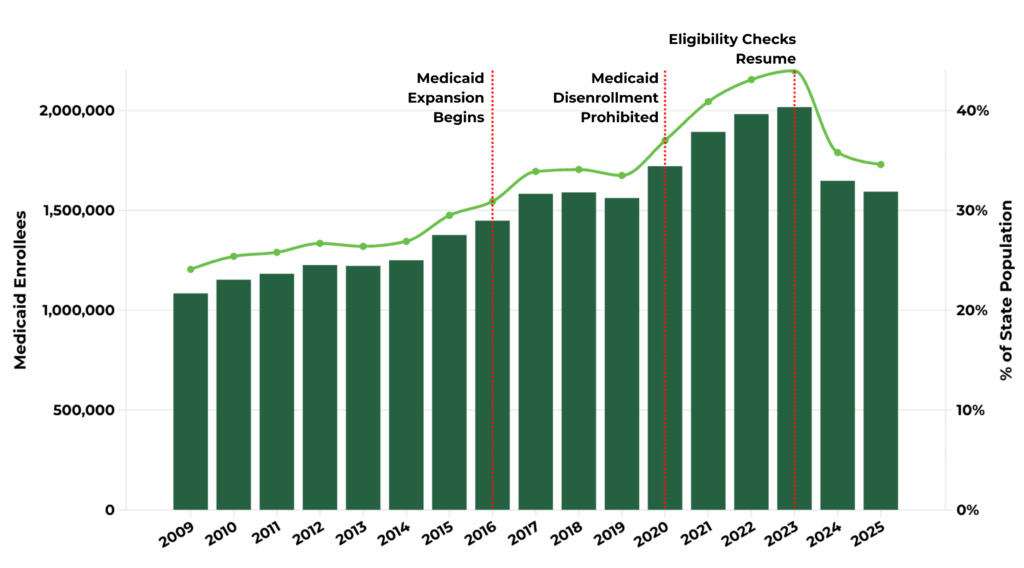
Source: Louisiana Department of Health (2009-2024 data is from July; 2025 data is from June)
Louisiana has one of the highest percentages of its population on Medicaid in the country, with 32.8% of resident enrolled, according to KFF data.
Louisiana’s heavy reliance on Medicaid for health care coverage is attributable to the state’s high poverty rate and its decision to expand the program as allowed under the Affordable Care Act to adults ages 19 to 64 with incomes up to 138% of the federal poverty level — $21,597 for an individual in 2025.
Medicaid Enrollment as a Percentage of Total Population
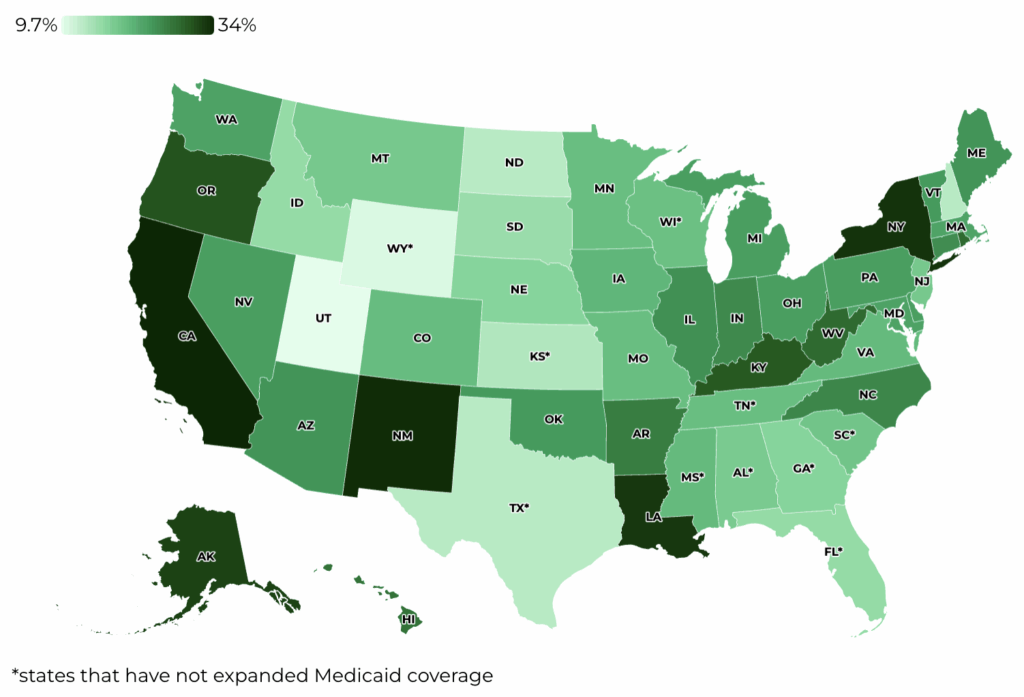
Source: Total Monthly Medicaid & CHIP Enrollment, Kaiser Family Foundation
Financing for Medicaid is shared by states and the federal government, with differing levels of federal dollars provided for the program based on a state’s per capita income compared to the national average.
Of Louisiana’s $21.2 billion Medicaid budget for the current financial year, nearly $16 billion, or 75%, is funded by the federal government, according to data from the Louisiana Legislative Fiscal Office.
Even as the number of people covered by Medicaid has dropped, the state’s budget for the program continues to grow because of medical inflation, increases in the rates paid to health care providers that treat Medicaid patients and other factors.
Recently passed federal budget and tax legislation called the One Big Beautiful Bill will reduce financing and change eligibility rules for the Medicaid program in the next few years.
Under the law, adults receiving health care through the Medicaid expansion program must work or participate in qualifying activities for 80 hours a month to maintain coverage. States must enact the work requirements by December 2026.
Most adults on Medicaid in Louisiana are employed, and 46% of those work full-time, according to KFF data.
The federal law changes also will require people in the expansion group to verify their eligibility more frequently, with verification checks at least every six months instead of yearly.
In Louisiana, the Department of Health conducts quarterly wage checks in addition to yearly renewals, with some exceptions for pregnant women, children and people in long-term care. Enrollees who do not regularly verify their income lose coverage.